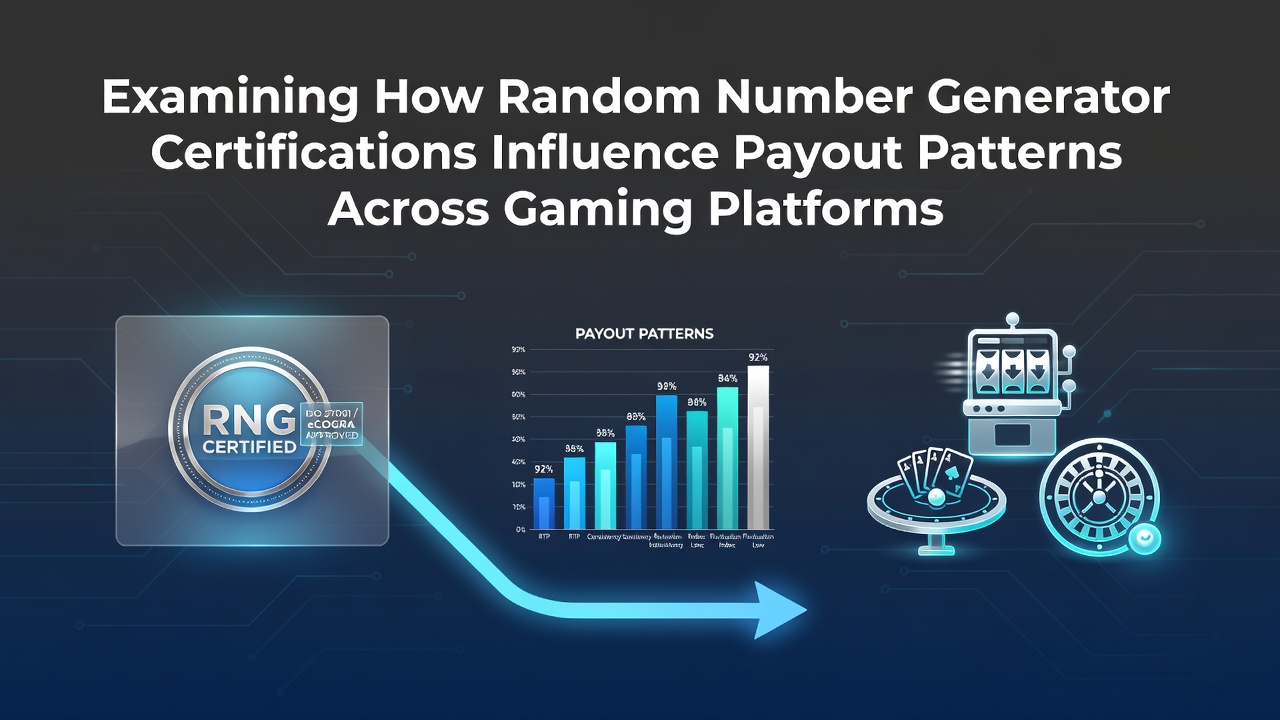
Analyzing RNG Certification Effects on Payout Distributions in Digital Gaming Environments
Random number generator certifications form a core element of regulatory frameworks that oversee fairness in electronic gaming systems, and these standards directly shape how payout patterns emerge across platforms. Testing laboratories evaluate RNG algorithms for statistical randomness, independence of outcomes, and resistance to predictable sequences before platforms receive approval to operate. Regulators in multiple jurisdictions require such certifications to confirm that return-to-player percentages align with advertised figures over extended play periods.
Certification bodies apply standardized test suites that examine millions of simulated game rounds, and results feed into reports that detail whether payout distributions match expected mathematical models. Platforms that maintain active certifications often publish aggregated data showing consistency between theoretical RTP values and observed player returns, while uncertified or lapsed systems face restrictions that limit market access.
Core Mechanisms of RNG Evaluation
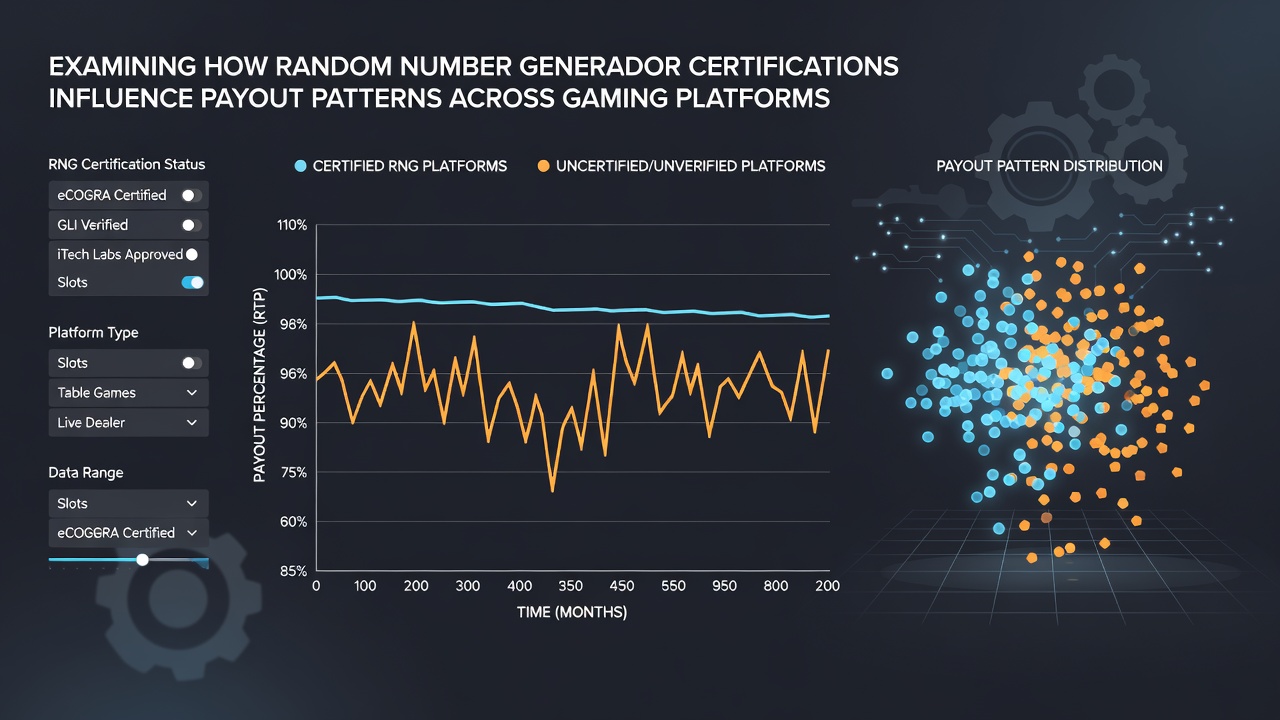
Laboratories conduct entropy analysis, chi-square testing, and serial correlation checks to verify that sequences lack bias, and these procedures occur both at initial launch and through periodic re-evaluations. When certification holds, operators must preserve the same RNG implementation that passed inspection, which prevents unauthorized modifications that could alter payout frequencies. Data collected from certified environments reveals tighter clustering around advertised RTP rates compared with platforms operating without equivalent oversight.
November 2026 updates from several testing authorities introduced enhanced requirements for live dealer integrations and mobile RNG modules, and these revisions addressed new variables introduced by cloud-based processing. Platforms adapting to the revised protocols reported smoother alignment between certified RNG outputs and actual payout logs submitted to regulators.
Regional Regulatory Approaches
Authorities in North America, Europe, and Asia-Pacific each maintain distinct certification pathways yet share common technical benchmarks. The Nevada Gaming Control Board publishes annual summaries that track RNG compliance rates and corresponding payout variance statistics across licensed sites, while Australia's state-level regulators publish similar aggregated figures covering electronic gaming machines. These reports demonstrate that certified RNG systems produce payout patterns with lower deviation from expected values during high-volume testing windows.
Industry associations such as the International Association of Gaming Regulators compile cross-jurisdictional data that links certification status to measurable differences in player return consistency. One study compiled by academic researchers at the University of Nevada, Reno examined transaction logs from multiple certified and non-certified operators and found reduced variance in payout intervals where RNG audits occurred quarterly.
Influence on Observed Payout Patterns
Certified RNG implementations enforce uniform probability distributions across reel positions, card draws, and bonus trigger events, and this uniformity translates into payout sequences that follow predictable long-term curves rather than erratic spikes. Operators using certified generators submit periodic RTP reports that regulators cross-reference against independent test results, creating a feedback loop that discourages drift in actual returns. Platforms without active certification often display wider fluctuations in short-term payout rates because no external verification enforces adherence to published mathematical models.
Statistical reviews of large datasets indicate that games running under current RNG certificates exhibit payout pattern stability measured by lower standard deviation in session-level returns. Those same reviews note that certification renewal cycles, typically every six to twelve months, coincide with recalibration events that realign any minor deviations before they accumulate into noticeable pattern shifts.
Technical Standards and Platform Implementation
Modern certification protocols require source code review alongside runtime testing, and this dual approach ensures that the deployed RNG matches the version submitted for evaluation. When platforms integrate third-party game content, each title must carry its own certification or demonstrate compatibility with the host site's certified RNG framework. Such layered verification reduces instances where payout patterns diverge from certified expectations due to mismatched random sequence generation.
Real-time monitoring tools now accompany many certifications, allowing regulators to receive automated alerts when statistical tests flag potential anomalies, and these tools operate continuously rather than solely during scheduled audits. Observers note that platforms adopting continuous monitoring show tighter adherence to expected payout distributions across multi-jurisdictional deployments.
Conclusion
RNG certification requirements establish measurable boundaries around payout pattern behavior by enforcing statistical standards that persist across software updates and jurisdictional changes. Data compiled from regulatory bodies and research institutions consistently shows reduced variance in returns when platforms maintain active certifications, while the absence of such oversight correlates with greater short-term fluctuations. As testing methodologies evolve to cover emerging platform types, the connection between certification status and payout consistency remains a central focus for regulators seeking uniform fairness outcomes across gaming environments.